Field Notes
Pouring through January
Cold weather does not stop a schedule. It stops contractors who did not plan for it. Here is the cold-weather concreting playbook we run from November to March.
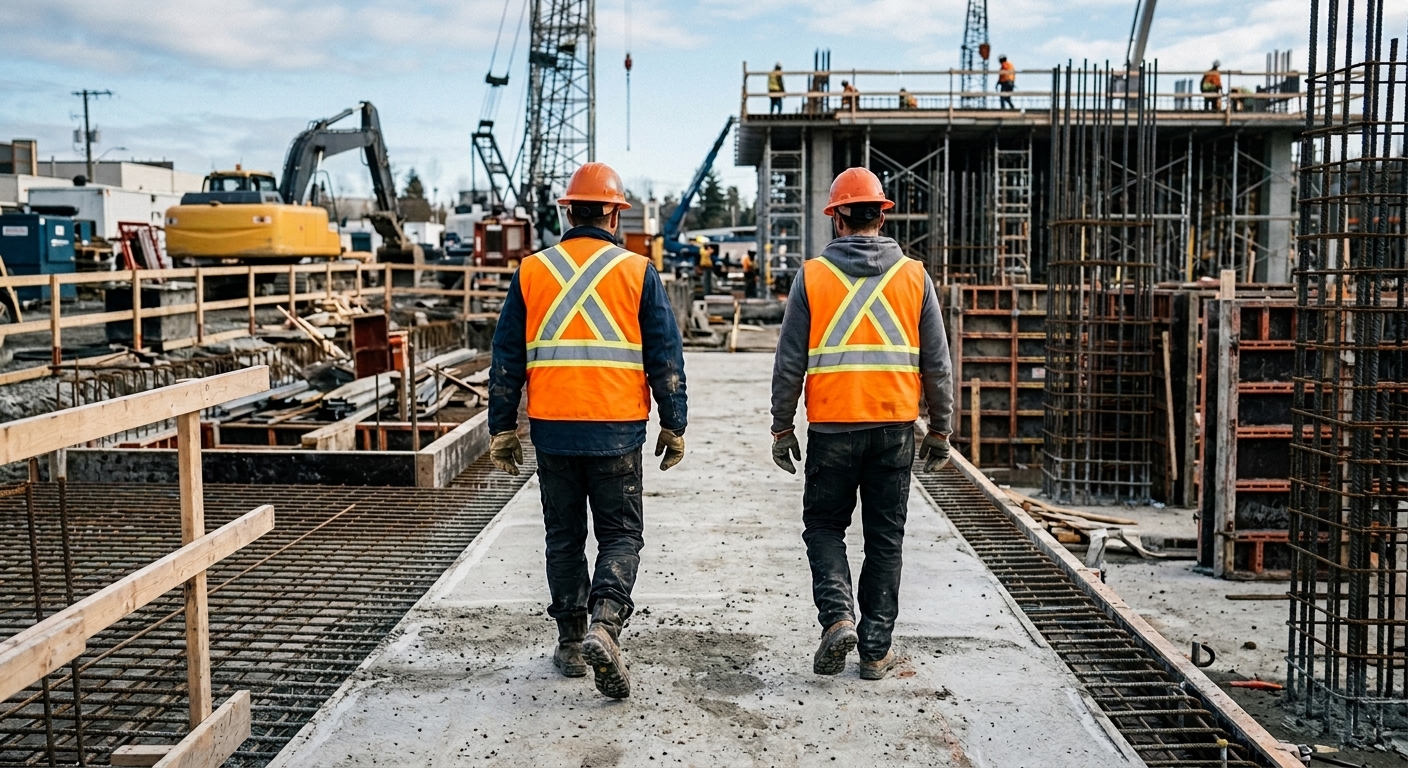
Every winter, somewhere in Ohio, a schedule dies on a frozen slab. The pour went ahead because the truck was booked, the blankets stayed in the trailer because the sun was out at 7 a.m., and by the time anyone pulled a cylinder, the damage was cast in place. The repair costs more than the pour did.
Concrete does not care about your milestone dates. Below about 40°F, hydration slows to a crawl; let fresh concrete freeze in its first 24 hours and you can lose up to half its potential strength permanently. The fix is not courage. It is preparation, and it starts weeks before the forecast turns.
Before the truck rolls
Our cold-weather plan is written into the project schedule in October, not improvised in January. Ground thaw or insulation on grade for at least 72 hours before a slab pour. Heated water and, where the mix design allows, accelerating admixtures batched at the plant. Windbreaks up before the crew arrives, because wind steals heat from a fresh surface faster than air temperature alone ever will.
During the pour
Concrete arrives between 55°F and 75°F, verified at the chute, and it never touches frozen ground, frozen rebar, or ice-glazed forms. We pour smaller sections in winter on purpose: a crew that can finish and cover 4,000 square feet before the surface chills beats a crew racing a 12,000-square-foot monolith against the sun going down at five.
The 72 hours after
Insulated blankets go down the moment finishing ends, doubled at edges and corners where heat escapes first. On enclosed pours we run indirect-fired heaters, vented, because unvented heaters dump carbon dioxide that carbonates a fresh surface into dust. Temperature loggers ride inside the blankets, and their curves land in the owner report alongside the break tests.
Proof, not promises
Field-cured cylinders travel with every winter pour, cured beside the slab they represent, under the same blankets. When we strip forms or load a deck, the decision rides on breaks from those cylinders, never on the calendar. That is the whole playbook: move the risk from hope to measurement, then publish the measurements.
A fictional field note written for this demo. Practices described reflect common cold-weather concreting standards (ACI 306 territory), but nothing here is engineering advice for a real project.
Building through a winter?
Ask us how the cold-weather plan lands in your schedule and your budget before you sign either one.
Start the conversation Fictional demo: form responses are simulated.